PCIGR’s multicollector ICP-MS instruments are configured to measure radiogenic isotopic ratios (Nd, Hf, Pb) and stable isotope ratios of elements ranging from Li to U, all at high-precision and on a wide variety of sample types.
| Make/model | Services |
| Nu Instruments Plasma II/3 | Isotopic analyses |
| Nu Instruments Plasma 1700 | High-resolution isotopic analyses |
PCIGR actively monitors the performance of these instruments through the analysis of standards (e.g., SRM 981, JMC-475, La Jolla or JNdi) and reference materials (USGS and others). To see a gallery of our historical instrument performance, click on the thumbnail image below.
PCIGR-radio-iso-analysis-SRM [PDF]
NuPlasmaIINu Instruments Plasma II/3
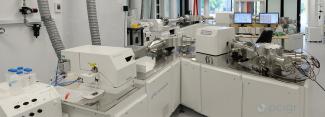
Nu Instruments Plasma II double-focusing magnetic sector ICP-MS, with upgraded Plasma 3 interface, in the nUBC facility at PCIGR. Photo: D. Weis.
PCIGR's Plasma II, with an upgraded high-sensitivity interface (Plasma 3), is a double-focusing magnetic-sector multicollector ICP-MS that features the following:
- Direct solution aspiration system, and DSN-100 (dry plasma) or Cetac Aridus II (dry plasma) desolvating nebulizer for increased sensitivity and reduced oxide formation
- High-sensitivity cones that increase overall sensitivity without compromising accuracy and precision
- 16 Faraday detectors and 5 full-size ion-counting multipliers for the study of multiple isotope systems
- Upgraded zoom optics for faster response time
Although mainly used for radiogenic isotopic measurements (Pb, Hf, Nd) in unit mass resolution, the Plasma II/3 at PCIGR is also capable of pseudo-high-resolution measurements when mass interferences are on the same side of the peak.
Ideal results (i.e., without loss of reproducibility) can be achieved with analyte quantities as low as 10, 20 and 25 ng for Pb, Hf and Nd, respectively, for isotopic measurement.
Contact pcigr@eoas.ubc.ca for details on instrumentation and submitting samples.
Consult the Fees page for analytical costs.
nuplasma1700Nu Instruments Plasma 1700
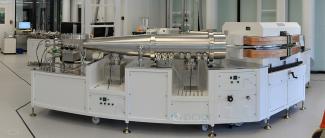
Nu Instruments Plasma 1700 high-resolution multicollector ICP-MS in the nUBC facility at PCIGR. Photo: D. Weis.
The Plasma 1700 is a double-focusing multicollector ICP-MS with a design that encompasses large geometry/mass dispersion and a unique collector slit. The system features the following:
- DSN-100 (dry plasma) or Cetac Aridus II (dry plasma) desolvating nebulizer
- Cetac ASX-110FR autosampler for long runs with minimized downtime
- Fixed source slit with three positions (LR, MR, HR), and alpha/beta slits before an electric sector analyzer for high resolution, precision and accuracy and minimal loss of sensitivity
- Slits adjustable in width and central position before each collector for independent variable resolution on each collector
- Fixed core of 10 Faraday detectors and 6 movable detectors with 3 on each mass side
- 3 ion-counting multipliers interspersed on the low-mass side
- High abundance deceleration filters available for each ion counting detector
- Enhanced variable zoom optics for maximum flexibility
The Plasma 1700 is used for the following isotope analyses:
- Routine radiogenic isotope analyses (Pb, Hf and Nd) at very high precision and accuracy
- Challenging Fe and Si analyses, with stable and reliable results, e.g., δ56Fe precision of 0.04‰ (2σ) in igneous rocks
Contact pcigr@eoas.ubc.ca for details on instrumentation and submitting samples.
Consult the Fees page for analytical costs.