PCIGR’s IRMS instruments are used for light stable isotope analyses in a variety of applications, such as geology, biology and archaeology.
Notes:
We only accept natural abundance isotope samples (i.e., no artificially enriched isotope samples).
We accept soil and sediment samples only on a case-by-case basis (non-commercial service).
We do not accept samples on glass fibre filters (GFF)
| Make/model | Interface | Peripheral |
| Thermo Scientific Delta V Plus | Continuous flow | EA, GasBench, IsoLink II GCC |
| Nu Instruments Horizon: Coming Soon! |
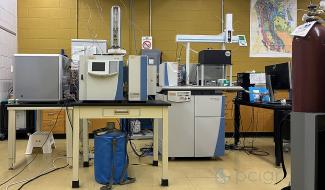
Stable Isotope Laboratory at PCIGR. Delta V Plus IRMS (Right) with GC, Gasbench and elemental analyzer (Left). Photo: A. Chang
Delta VThermo Scientific Delta V Plus
The Thermo Scientific Delta V Plus is a versatile continuous-flow IRMS and features the following:
- ConFlo IV Universal Continuous Flow Interface
- Sensitivity of 1100 molecules per CO2 ion with continuous flow
- Fast switching magnetic analyzer with ability to measure 3 isotope ratios in a single sample injection
- Faraday collectors for C, N and O isotopes
PCIGR adopted the Delta V Plus from UBC's Laboratory of Archaeology. The system is plumbed into peripheral analyzers for analyses that fit into the following categories:
- carbon and nitrogen isotopes in organic materials (plants, extracted bone collagen, feathers, muscle, keratin, etc.) via an Elementar Vario Micro Cube Elemental Analyzer (EA)
- carbon and oxygen isotopes in carbonates (soil carbonates, carbonate rocks, tooth enamel, fish otoliths, shells, etc.) via phosphoric acid digestion using a GasBench
We can provide %C and %N (elemental concentration) alongside stable isotope values, but we do not offer a stand-alone elemental concentration service at this time.
Please consult the guide below on how to prepare and submit samples for IRMS analysis via EA and GasBench:

IRMS Sample Submission Guide [PDF]
The Delta V Plus is also connected to an IsoLink II Gas Chromatograph-Combustion (GC-C) interface for carbon and nitrogen compound-specific isotope analysis (CSIA) in derivatized liquid samples, such as amino acids, fatty acids and leaf waxes.
These analyses are not available on a commercial basis. If you have a project needing development, contact Prof. Kendra Chritz for details on instrumentation and submitting samples.
For all other analytical costs, consult the Fees page.